

Next Sunday the Capuchin Friars will celebrate the 10am Mass at St Cuthbert’s. Please give them a warm welcome.
All posts by Parish Priest

Lay Dominican NE Study Day
On Saturday 15th November, starting at 11am, you are invited to come along to a short Lay Dominicans Study Day on the theme of “Aquinas and Hope”, led by Rik van Nieuwenhove, Professor of Medieval Thought at Durham University.
The Study Day will begin at 11am and finish by about 3pm. including time for Mass and a simple soup lunch. There is no charge but donations would be welcome and it would be helpful for catering purposes if you could let Andy Doyle (andydoyle1066@sky.com) know if you intend to come along.
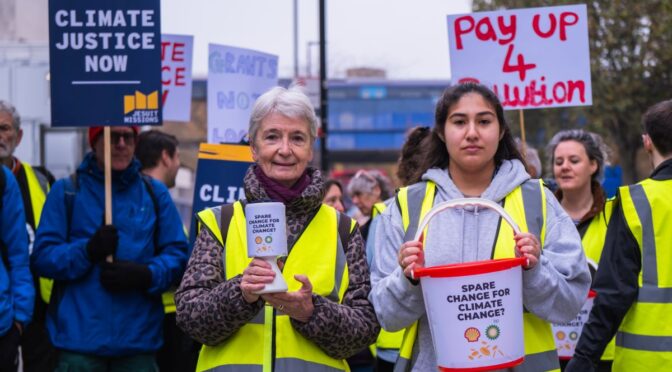
Take action for COP30

Assisted Suicide
The Bill to legalise assisted dying is passing through the House of Lords. You can find guidance on how to write to a peer at: https://www.cbcew.org.uk/contact-peers/
Called to be saints
Today the Church celebrates the Feast of All Saints. We remember the saints who are not famous – all the good and holy people who have ever lived, who put their faith in Christ and have now been welcomed home to take their place in God’s kingdom. Today’s First Reading speaks of ‘a great multitude that no one could number, from every nation.’ They are our friends and one day we hope to join them. The late Pope Francis said that the saints are not ‘supermen’ and are not ‘born perfect,’ but rather, ‘They are like us… people who before reaching the glory of heaven lived a normal life, with joys and griefs, struggles and hopes.’
In today’s Gospel reading Jesus, addressing the crowd from the mountain top, sets out the values of the kingdom of God, which are very different to the values of this world. Blessed are the poor in spirit, who put their trust in God. Blessed are those who mourn. Blessed are the meek. Blessed are the merciful. To live by these values is a challenge, but that is what Jesus calls his disciples to do. If we respond to the Lord’s call with all our hearts, we will help to change the world by our example and witness. We will be saints.

Parking Sunday 9th November

Book Sale
If anybody would like to donate any books in good condition for the Craft Fayre and Book Sale in aid of the Church House Stonework on Saturday 22nd November, please bring them along before that date and leave them in the sacristy. If you have a lot of books and need help with transporting them, please contact Andy Doyle (andydoyle1066@sky.com).

Catholic Theology Research Seminar
Language of the Abyss in Bonaventure’s Texts by Dr Michael Hahn, the Dom Gregory Dix Lecturer in Christian Spirituality at Sarum College. Thursday 6th November in Seminar Room B, Abbey House, Palace Green. Seminar at 4pm, followed by drinks in the staff common room. You can also take part in the seminar online – contact ccs.admin@durham.ac.uk for details.
God, be merciful to me, a sinner!
Today’s parable presents us with a contrast. Two men are praying in the Temple. The Pharisee seems like a model believer, who follows all the commandments of God’s Law. The tax collector will be despised by his fellow Jews for collaborating with the Roman rulers – and tax collectors were notoriously corrupt and dishonest. Yet, Jesus tells us, the tax collector rather than the Pharisee goes home justified.
The key to the parable is in its introduction. Jesus was speaking to people who ‘trusted in themselves that they were righteous.’ The Pharisee trusts in his own righteousness – his prayer is a list of the things that he has done for God. He sees no need to repent or to ask God for forgiveness of his sins. The tax collector, on the other hand, knows himself to be a sinner and can only beg for God’s mercy.
We can never ‘trust in ourselves’ for our salvation and we can never allow ourselves to treat others with contempt, as the Pharisee treats the tax collector. We all stand before God as sinners and we can only pray the prayer of the tax collector: ‘God, be merciful to me, a sinner!’
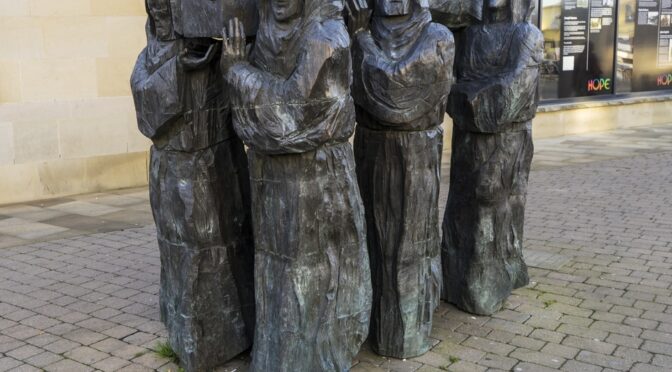
Jubilee Pilgrim Walk
Join us for a pilgrimage walk around the city to mark the Jubilee Year and its theme, ‘Pilgrims of Hope.’ The focus of the walk will be the art of local sculptor Fenwick Lawson, making a number of stops to pray and reflect with his works. Everyone is welcome.
We will gather at 1.30pm this Sunday, 26th October by ‘The Journey’ sculpture in Millennium Square. The walk will take around two hours in total, and you’re welcome to break off for a cup of tea at any point!
Find out more about the life and work of Fenwick Lawson here.
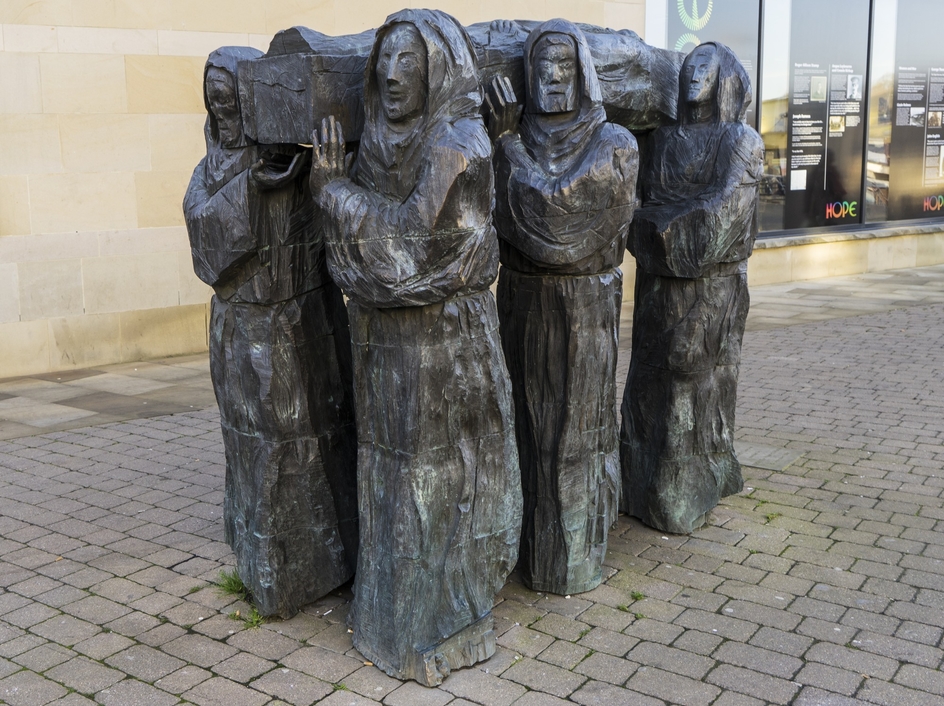
Image credit: Lynda Golightly/Art UK
Tradition v Change? The Creed of Nicaea and the Development of Doctrine.
Does faith change or does it stay the same? A public lecture for the 1700th anniversary of the Council of Nicaea, by Prof Karen Kilby, holder of the Bede Chair of Catholic Theology and director of the Centre for Catholic Studies at Durham University. Thursday 30th October at 7.00pm, at St Cuthbert’s.

Stella Maris
The annual collection for the Apostleship of the Sea raised £316 (plus Gift Aid.) Thank you for your support.
Stella Maris chaplains visit ships entering ports in the NE. Many of the seamen on board are from southern Asia and are ill-equipped for conditions in the chilly North Sea so as well as offering spiritual help they often take a practical gift of a warm hat. Now that dark nights are here again you can make a gesture of support by knitting hats which the parish can send to the chaplains. The recommended pattern is on the parish website or paper copies are available at the back of church.

Life in the Spirit Seminars
Crying out for justice
The parable in today’s Gospel describes a scene that would be familiar to Jesus’ disciples. The judge is a powerful man, while the widow is vulnerable – a woman alone in a male-dominated society. But she is fearless. She persists in demanding justice from the corrupt judge, until she wears him down and he gives her what she is asking for. Jesus is encouraging his disciples not to give up when they are faced with suffering or injustice. God has not forgotten them and, unlike the unjust judge, God will not ignore their prayers.
The parable teaches us that we should not be afraid to ask God for what we need. God is not an unjust judge but a loving Father and, Jesus tells us, God hears the cries of the chosen ones or the ‘elect.’
In our own time, we see that the poor and the powerless suffer injustice, while those who have power often seem unwilling to act. To cry out to God in the face of the evils of our world is an expression of our faith, and we must not be discouraged. Jesus teaches his disciples ‘always to pray and not lose heart.’

Congratulations

Clocks go back!

Scriptures of Hope
Reflections for the Jubilee Year at https://diocesehn.org.uk/news/scripture-of-hope-publication/
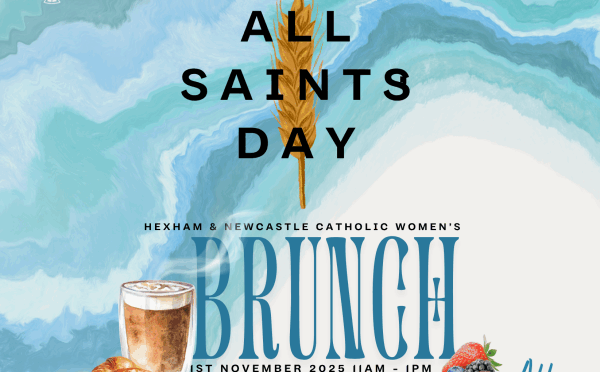
“All Saints’ Day: Brunch by the Sea”
An invitation for women in the Diocese of Hexham & Newcastle to come together to share brunch and a time of prayer and reflection led by Sr. Sheila McNamara. 11am – 1pm on Saturday 1st November at St Cuthbert’s, Albion Road West, North Shields, NE29 OJB. Please bring pastries, fruit or other to contribute to the bring and share brunch table. To RSVP or for more information please contact: Mary (mmadziva@ymt.org) or Amy (formation.mission@diocesehn.org.uk).
Diocesan Events
Liturgical Day of Reflection for Existing Ministers of Holy Communion: Called to the Supper of the Lamb, led by Fr Mark Millward. Saturday 25 October, 10.00am – 3.00pm, St Augustine’s Parish Hall, Larchfield Street, Darlington. Cost: £15.00 per person. Booking link: https://forms.office.com/e/ZP2PychHaD (or contact the Parish Office.)
Your faith has made you well
Ten men cry out to Jesus as he journeys towards Jerusalem. The men are lepers. Because of their disease, they are excluded from their families and their communities. They are living on the edges, completely isolated.
Jesus has compassion on the men and sends them to the priests, who can confirm their cure and restore them to their place in society. Ironically, the one man who returns to give thanks is a Samaritan. Though no longer a leper, he is still an outcast, because of the hatred that existed between Jews and Samaritans. Jesus tells the man, ‘Your faith has made you well.’ His praise and gratitude are an expression of his faith in Christ. Did the other nine men also come to faith after their healing? We don’t know.
We often divide and exclude, but God’s love has no boundaries. Jesus heals all ten men, making no distinction between Jews and Samaritans. He calls everyone to faith – and thanksgiving is an important aspect of faith.
This week, Pope Leo published his first papal document. In it, the Pope tells us that ‘Love for the Lord… is one with love for the poor.’ Our faith in Christ compels us to give thanks for what we have and to love as the Lord does, without boundaries.