

As we come to the fourth Sunday of Lent, change is coming. We look up from our penitential practice, to the horizon. Rose-coloured vestments suggest the dawning light of the Easter morning. We sing benedictus qui venit… (blessed is He who comes in the name of the Lord) with a fresh anticipation. Though Lent is not over — we have three weeks yet! — we have made it halfway. If we have not been as disciplined as we had hoped, here is an opportunity to make a fresh start. With the Lord, it is never too little, too late.
Just as the father received back his son, the one who had squandered everything and debased himself; just as the father welcomed and forgave the older son who sulked, so also he holds his arms open to us. Whatever we have done or failed to do this Lent, now we can put it behind us and, even in the midst of Lent, try again. Now, as ever, we depend not on our own merits, but on God’s abundant mercy. He waits for us, with a patience that is unimaginable.
As we return to him, as we are called to do especially in Lent, we begin to receive the joy that will be ours on Easter morning. So let us unite ourselves to the one ‘who comes in the name of the Lord’ now in our penitence, that come Easter we may be found in him, rejoicing.
Part of a series by Medi Ann Volpe

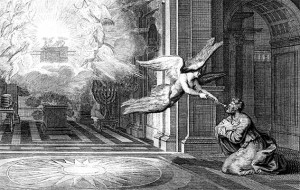 The scene that follows the announcement ‘holy, holy, holy’ is dramatic: ‘the foundations of the thresholds shook at the voice of him who called, and the house was filled with smoke’. Isaiah’s response is not worship, as we might expect. Instead, he exclaims, ‘Woe is me!’ Seeing the holiness of the Lord makes Isaiah aware of his own lack of holiness, and fearful: ‘a man of unclean lips’ should not (he thinks) behold ‘the King, the Lord of hosts’. God’s glory shows up all that is unworthy about us. Similarly Peter, in the gospel reading from a few weeks ago, responds to the miraculous catch of fish: ‘Depart from me, O Lord, for I am a sinful man’. Beholding the greatness of the Lord brings about a new, and unsettling, revelation of our own lack of sanctity. The response from on high is not judgement, however, but comfort. One of the seraphim brings a burning coal from the altar, touches Isaiah’s lips with it, and announces, ‘Behold…your guilt has been taken away, and your sin forgiven’. Likewise Jesus reassures Peter (in the same words the angel used to put Mary at ease): ‘Do not be afraid.’
 During Lent, we direct our attention to the holiness of God more than at any other time of year. Not only that: we strive to imitate that holiness. One of the ways the Church has called the holiness of God to our minds comes from the sixth chapter of Isaiah: the prophet sees the seraphim, who call out to one another: ‘holy, holy, holy is the Lord of hosts; the whole earth is full of his glory.’
 Although little noted in our contemporary liturgical observance, Septuagesima Sunday once marked an important point in the Church’s year. In the middle ages, some religious began the Lenten fast at Septuagesima, not forty days but up to seventy (as the word indicates) days before Easter. Before Lent properly began, there was a ‘little Lent’, a time of preparation for the penitential season. Even though we no longer observe this ‘little Lent’, there are good reasons at least to mark the day. My attention was drawn to the Church’s bygone practice in a homily I heard a few years ago, which has shaped my attitude to Lent (and in good measure to the spiritual life more generally). Lent is a time of preparation for Easter, but the mode of our preparation is not prescribed with rigorous detail. (More to come on what is specifically asked of the faithful during Lent.) We choose to give up things we enjoy, or take on things which will challenge us.
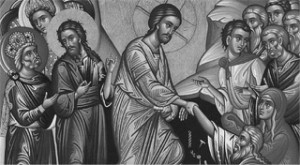 The creed concludes by directing our attention to our own end: we ‘look forward to the resurrection of the dead and the life of the world to come’. Maybe by the time we get to the last line, our attention has moved on to the next part of the Mass, or even to what’s for Sunday lunch. Or maybe the repetition week by week has dulled our perception of its oddity. The resurrection of the dead? The life of the world to come? However often we say these things, and however much we might know about the Church’s teaching on resurrection and new life, the future remains ultimately mysterious: we believe, but we do not grasp these things.
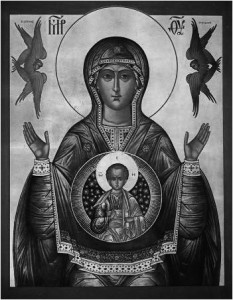 Last week we focused on the eschatological dimension of our faith in Christ – its relation to the end of this world. As Advent begins, we turn to the identity of Jesus as the eternally begotten Son of God.
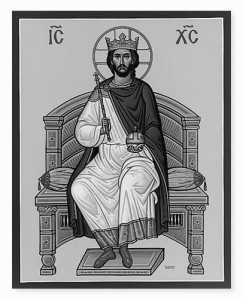 The creed answers the question, ‘who is Jesus?’ from three angles. First, the creed tells us who Jesus is from eternity: Son of the Father Almighty. But unlike human sons, who are like and unlike their fathers, Jesus is of the Father’s being, like the Father in every way. He is fully God.
 Taken in isolation, reference to the all-powerful God might be frightening rather than comforting. After all, in the contemporary world power is suspect, and absolute power all the more so. But God’s power is not corruptible, and it cannot be considered in isolation from three truths about the divine.

 When we say the creed each Sunday, we proclaim the faith into which we were baptized. Although we are not entirely certain where creeds come from, we know that catechumens in the early Church had to learn answers to a series of questions about the core beliefs of the Church. They repeated these publicly as part of their baptismal ceremony to attest to their belief. Creeds may have originated in part as a condensed version of these answers, and would have varied locally (one of the most famous surviving examples is known to us as The Apostles’ Creed – it was actually the local creed used in Rome). The Council of Nicaea produced a Creed in 325 and later in the same century the Council of Constantinople (381) produced another which it said expressed the faith of Nicaea, and it is this we use today. Bishops had to sign up to this creed when they were ordained, and gradually, over many decades it came to be used in the liturgy and in catechesis.
