
Will celebrate both Masses at St Cuthbert’s on Sunday 28th April, while Fr Andrew is in Malta for Deacon Matthew’s ordination. Please give him a warm welcome.
Walking With Jesus
In Holy Week, we walk with Jesus through his Passion. Today, on Palm Sunday, we join the crowd of disciples who welcome the Lord as he enters Jerusalem. On Holy Thursday, we are present at the table of the Last Supper, and watch with Jesus in the garden, as he faces the horror of the death that awaits him. On Good Friday, we are witnesses to his condemnation, crucifixion and death. On Holy Saturday, we wait quietly, before sharing in the joy of the Resurrection on Easter night.
The Church’s liturgy invites us also to share in the emotions of the Passion. Jesus is betrayed by Judas and abandoned by all of his closest friends. The crowd who welcomed him with ‘Hosannas’ shout for his blood. On the Cross, he even feels forsaken by his Father. He dies, mocked and discredited. The Son of God empties himself completely for our sake. The more deeply we enter into the reality of Christ’s sufferings, the more we will understand the depth of God’s love for us, and the greater our joy in the Resurrection.
Diocesan Pilgrimage to Lourdes
Our diocesan Pilgrimage to Lourdes, from 26th July – 2nd August still has several places available for those who need Nursing Care or who are unable to travel or stay in Lourdes on their own. Flights are from Newcastle directly to Lourdes. Accommodation will be in the Accueil Marie St Frai and there will be the assistance of the pilgrimage nurses and doctors throughout the week in Lourdes as well as many helpers. The cost for those staying in the Accueil is £895.00 per person. Anyone wishing to go is asked to contact The Lourdes Pilgrimage Office at St Robert’s Morpeth (01670 513410 or lourdes@rcdhn.org.uk ) for a Booking Form and Medical Consent Form. A medical assessment will be made to make sure the pilgrimage can offer the appropriate care. Closing date for application is 21st April.
Call for Papers
Durham World Heritage Site Lecture

Finchale Partnership Open Afternoons
People often say they would like to know more about the other parishes and churches in the partnership. So, 5 of our churches will host an open afternoon between May and October 2019. The first one will be at Ss Joseph, Patrick and Cuthbert, Coxhoe on the afternoon of 5th May. Please see the poster on the noticeboard for more details.

Churches Together in Elvet & Shincliffe for Holy Week

Around the Church
Lenten Evening Devotions
EU Citizens
The Church is offering support to EU citizens living in the UK and concerned about the effect of Brexit on their situation. You can find important information at www.eurights.uk
Job Opportunity
The Diocesan Department for Safeguarding is looking to appoint an Administrator. Closing date: Wednesday 10th April. See www.rcdhn.org.uk for details.
Women like this…
It takes two to commit the sin of adultery. But only the woman is brought to Jesus. She is publicly humiliated by the scribes and Pharisees – made to stand in full view of the crowd. The Law of Moses prescribed stoning to death as the punishment for adultery, but by Jesus’ time, that penalty had fallen into disuse. Jesus’ opponents are setting a trap for him. Will he contradict the Law, or will he encourage the crowd to lynch the woman there and then? The accusers are full of righteous indignation. Jesus’ response shows up their hypocrisy. Not one among them is confident enough of his own sinlessness to throw the first stone.
We live in an unequal society. It is still, often, women, the poor or the powerless who are judged and condemned. As disciples of Christ, we must not be self-righteous accusers. Knowing our own need for God’s mercy, we should follow the example of the Lord, who does not condemn.
St Leonard’s School Spring Concert

Around the Church
Partnership Mass
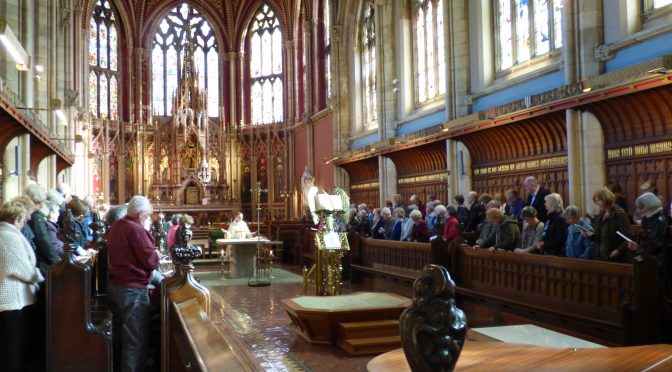
Bishop Robert will be visiting the Finchale Partnership on Wednesday 10th April. The day will end with Mass in Ushaw College Chapel at 7.00pm, followed by refreshments.
Please sign up today if you are planning to come, so that we can give Ushaw an estimate of numbers. Also, please indicate if you need a lift to Ushaw, or can offer a lift, so that we can coordinate car-sharing.

A message from Deacon Matthew
As we enter the final month before my Ordination to the priesthood, I would like to thank you for the prayers and support you have been giving me. God willing, Ordination is on Saturday 27th April in Malta’s Co-Cathedral in Valletta. I understand that it’s probably too far to travel, but I would ask you for your kind support through prayer, so that I may truly become a witness to the Suffering Servant.
Fr Liam

Partnership Reconciliation Service
Foot Washing

The Parable of the Forgiving Father
We know today’s Gospel as ‘The Parable of the Prodigal Son.’ But perhaps we should focus instead on the father in the story. He is hurt by both of his sons. The younger son asks for his share of the family property without waiting for his father’s death, then leaves home as soon as he can and burns through his inheritance. When he comes back to his father’s house, no doubt expecting a frosty reception, he finds instead that his father is waiting anxiously for him, wanting to welcome him home and celebrate his return. The elder son reacts angrily to his father’s forgiveness of this wayward brother. It seems that, although he has worked dutifully on the farm, he is full of resentment. Once again, the father comes out to seek his son and to bring about a reconciliation.
In this parable, Jesus reveals to us the limitless compassion and mercy of God, our Father. When we fall into sin, God seeks us out, brings us home, and celebrates when we are reconciled to him. The season of Lent is the time to turn back to God for mercy, especially in the Sacrament of Reconciliation.