

Online Gospel Reflection is on Thursday at 6.00pm. Everyone is welcome to join us to reflect together on the Gospel reading for the following Sunday. The reflection lasts about 45 minutes. For the log in details, see the St Cuthbert’s Parish Community Facebook page or email margaretdoyle1066@sky.com
Stay Awake!
This Sunday we begin the season of Advent, when we prepare to welcome the Son of God at Christmas. In the reading from Luke’s Gospel, Jesus warns his disciples of the time of trial that is to come. There will be signs in the natural world, turmoil and destruction. But the disciples of Christ do not need to be afraid. They can stand up straight and hold their heads high. They have put their trust in God.
We believe that this world will come to an end and that the Son of God will come again in glory to judge all the nations of the earth; but we do not know when the Second Coming will be. Jesus teaches his disciples to stay awake and not to be ‘weighed down,’ either by the pleasures of this life or by its demands. Paul reminds the Thessalonian Christians to love God and love one another. There are many difficulties in our own lives and many terrible things happening in the wider world, but we learn from the Gospel to stand firm. If we are living by the teachings of Christ, then we do not need to fear judgement. We can trust in God’s mercy.
St. Joseph, Carpenter and Builder
Pastoral Letter

Introducing the ESV-CE Lectionary – 4
Most Sundays at Mass, we hear readings from both the Old and New Testaments. The Catechism of the Catholic Church tells us that: “Christians read the Old Testament in the light of Christ crucified and risen… (But we must not) forget that the Old Testament retains its own intrinsic value as Revelation reaffirmed by our Lord himself. Besides, the New Testament has to be read in the light of the Old. Early Christian catechesis made constant use of the Old Testament. As an old saying put it, the New Testament lies hidden in the Old and the Old Testament is unveiled in the New.”
The new translation of the Scriptures that use in the liturgy from today, the English Standard Version – Catholic Edition (ESV-CE), gives life to these words in a systematic and deliberate way. The ESV-CE seeks – where it is appropriate and supported by the original languages – to make explicit the connections between the Old Testament and the New. Where the New Testament quotes from or alludes to the Old, the ESV-CE aims to match up the wording in both. In this way, the ESV-CE attempts to stress the unity of the entire Bible – the Word of God, inspired by the Holy Spirit and spoken through human words.

Food & Faith

A Christmas Evening for Gaza
An evening of music, film, poetry and conversation with special guests from Palestine. Wednesday 4th December, 7pm at Elvet Methodist Church. The event is free, though it is advisable to book tickets. full details and to book amostrust.org/christmas-appeal
My kingdom is not of this world
Today on the last Sunday of the Church’s year, we celebrate the Feast of Christ the King. In the reading from John’s Gospel, Jesus is on trial for his life before Pontius Pilate, the Roman governor. Pilate was a ruthless imperial ruler and his main concern was that Jesus might be a threat to his authority – hence his question, ‘Are you the King of the Jews?’ Pilate’s retort to Jesus, ‘Am I a Jew?’ shows his contempt for the people he governed.
Pilate understood power and politics. He would never understand Jesus, who stood for different values. Christ is a King, but his kingdom is not of this world. He did not command an army or live in a palace. The Son of God came into the world to fulfil his mission from the Father and to bear witness to the truth. Today’s feast
challenges us to choose which king we wish to follow. We can serve the false gods and the corrupt rulers of this world; or we can follow the one true King who gave his life for us on the Cross and who rose from the dead to save us from our sins.

World Youth Sunday
World Youth Sunday 2024 is celebrated this Sunday, 24th November. This year’s theme is ‘Let Your Kingdom Come.’ Please pray for all of our young people and those who minister to them. There will be a retiring collection at Mass today to support Youth Ministry in our diocese.
Bishop Stephen has written a letter for Youth Sunday – you can read it here.
Introducing the ESV-CE Lectionary – 3
From next Sunday, we shall hear the Scriptures being proclaimed at Mass from a new translation, the English Standard Version – Catholic Edition (ESV-CE). When this happens, two significant factors are worthy of attention, one ecumenical and the other global.
Firstly, the roots of the English Standard Version (ESV) are to be found amongst Protestant evangelical scholars seeking to follow in the tradition of the King James Bible of 1611 and its twentieth century descendant, the Revised Standard Version (RSV). Notably, the New Testament element of the King James Bible was influenced by a Catholic translation prepared in Rheims in 1582 by members of the English College at Douai, part of which moved ultimately to Ushaw following the French Revolution. Also of note is that the RSV is one of the English Bible translations most frequently used in the Catechism of the Catholic Church.
The ESV was reviewed by a team of Catholic biblical scholars before permission was granted by the Holy See for the use of the ESV-CE in the liturgy. As such, although the development of the ESV-CE is not formally an ecumenical venture, this work of translation is one in which Catholics and Protestants have been able to collaborate in a way envisaged by the Second Vatican Council in its document ‘Dei Verbum’.
The second significant factor is that the ESV-CE has been the fruit of the work of the Catholic Church in India. Cardinal Oswald Gracias, Archbishop of Bombay (Mumbai), has described the ESV-CE as “the Indian Church’s contribution to the universal Church.” We often hear of the global church and of a shift away from a Western-centric approach to the church’s life. In the ESV-CE, we have a tangible example of this shift and of the reminder we sometimes need that the church is indeed Catholic, that is, universal.

Thank you

A Workshop on Synodality
On Saturday 30th November Ushaw will be hosting a Workshop on Synodality, with Guest Speaker, Professor Anna Rowlands.
This is a chance to find out more about the worldwide Synod, and also to bring together people from across our Diocese to explore how we can use the synodal approach locally, to help everyone to participate in the life of our local churches.
The day runs from 11am to 3.30pm, and tickets cost £10. Further details on Ushaw’s website at https://ushaw.org/whats-on-at-ushaw/ , where you can also book your tickets.
Oppose Assisted Suicide
Bishops are calling on Catholics in England and Wales to unite in prayer and compassionate action to oppose assisted suicide. A new bill on assisted suicide has been tabled by Kim Leadbeater MP and is before the House of Commons. The proposed legalisation undermines the sanctity and dignity of human life. We are a praying community. Please pray that our lawmakers will act wisely and will value human life. Please contact your local MP to express your views. The charity Right to Life UK has a simple online mechanism to do this with a provided factual letter. It can be found on the Bishops’ Conference website together with materials explaining the Church’s grave concerns about the proposed legislation at;
Oppose Assisted Suicide
Thank you for your prayers and action. Bishop Stephen.
There are also pre-printed postcards available in church that you can send to your MP to express your concern. The latest statement from the Bishops of England, Wales and Scotland can be read here.
My words will not pass away
In Jesus’ time, his people lived under the power of the Roman Empire. They longed for freedom and many hoped that Jesus would lead an uprising against Rome; but Jesus was not that kind of King. Instead, he taught his disciples that all the powers of this world would come to an end. They could read the signs of nature; they knew that a fig tree would grow and develop according to its nature. Jesus taught them to watch for the signs of the coming of the end times. Those who are powerful in this world will answer to God’s judgement, as we hear in the First Reading from the prophet Daniel.
As we look around our world, we can see wars and natural disasters, violence and turmoil. We may feel anxious and fearful, but we can stand firm if we trust in God’s love and mercy. The Opening Prayer of today’s Mass asks that we may ‘serve with constancy.’ The heavens and the earth themselves will pass away, but the words of Christ will not pass away. His teaching is a message for all time: a Word that we can trust.
Month of The Holy Souls
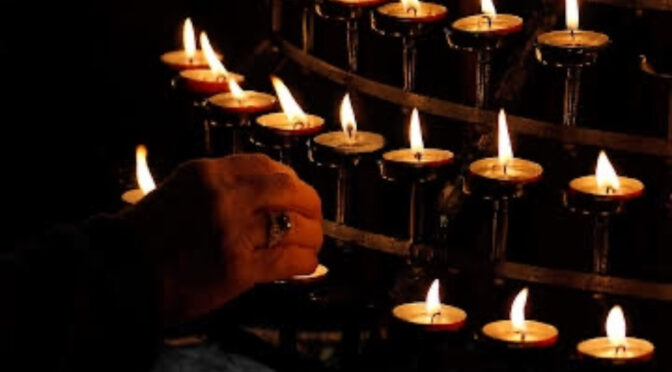
November is the month in which Catholics bring to mind those who have died and pray for their souls. From All Souls Day (November 2nd), our Parish Book of Remembrance will be placed on the font and opened for you to write within it the names of your departed family members and friends. If you cannot come along to church in person, please e-mail Andy Doyle (andydoyle1066@sky.com) and he shall arrange for names to be added.
St Patrick’s, Langley Moor
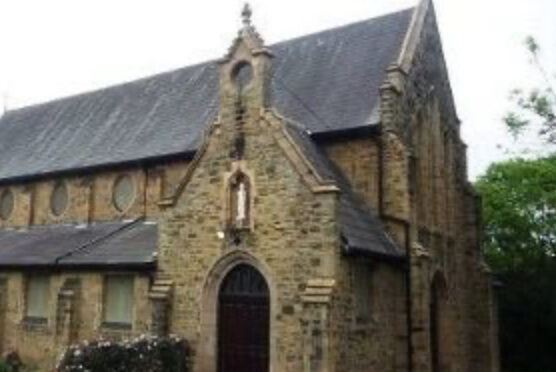
Fr Gordon Ryan, the Priest in Residence at St Patrick’s, will be away from the parish for some time after medical treatment scheduled to take place this week. As a result, Fr Andrew will be spending more time at St Patrick’s and will be celebrating the Saturday Vigil Mass there for the next few weeks.
Red Wednesday
Introducing the ESV-CE Lectionary – 2
When the English Standard Version – Catholic Edition (ESV-CE) Lectionary is introduced on 1st December, we will hear the Scriptures spoken at Mass in English as we have for many years, but with a new accent and dialect.
The translation of the Bible has a long history, starting in the Bible itself as we read in Nehemiah, chapter 8. Here in the North East, our own local Saint Bede translated the Gospel of John from Latin into Old English in the eighth century.
There are broadly two methods that can be used in approaching the work of translation.
In the Jerusalem Bible that we have become accustomed to hearing at Mass over the last 50 years, the translators used what is sometimes called “dynamic equivalence.” This method does not adhere strictly to a word-for-word translation but attempts a sense-for-sense translation that the translators believe communicates the meaning of the original Hebrew and Greek texts.
In the ESV-CE, the translators have used what is sometimes called ‘formal equivalence’, a more literal, word-for-word translation which attempts to stay as close to the original Hebrew and Greek texts as possible whilst rendering the text into readable English. In selecting the ESV-CE for our new Lectionary, our bishops are keen for us to get as close to the original texts as possible.
Bishop Dunn Memorial Lecture
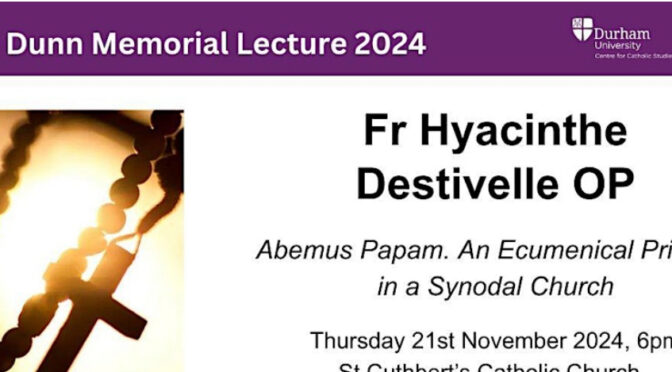
The Centre for Catholic Studies at Durham University is pleased to announce that booking is now open for the Bishop Dunn Memorial Lecture, with Fr Hyacinthe Destivelle giving a talk entitled Habemus Papam. An Ecumenical Primacy in a Synodal Church.
The lecture will take place here at St Cuthbert’s Catholic Church, Old Elvet, DH1 3HL, on the 21st November 2024 at 6pm, and will be followed by a drinks reception. This is to be an in-person event only, with no hybrid option. Please book your attendance at the following link:
