

If you are looking for some Lenten TV then you may wish to consider watching ‘The Chosen’, the first multi-season series on the life of Christ.

Lent soup lunches

Lenten Vespers and Stations of the Cross

Canonical Investigation – Parish Survey
Archbishop Malcolm McMahon, as Metropolitan, has been asked by the Dicastery for Bishops in Rome to prepare an in-depth report into the events leading up to the resignation of Bishop Robert Byrne. Archbishop Malcolm has commissioned Carol Lawrence, Chief Operating Officer of the Shrewsbury Diocese, to carry out this investigation.
The investigation has now issued a survey to be completed by parishioners. This is an anonymous survey, all answers are provided in complete confidence, and you are asked to give your own individual views. The survey will run until Monday 27 March 2023 and can be accessed at https://forms.gle/wevQ6zrj1t8SCxNq5 or through the Diocesan website, or by scanning the QR code below.. Please complete the survey only once, even if you hold more than one role in the Diocese.


Synod 2021-24
See the latest information on the Synod process, and read the ‘Working Document for the Continental Stage’ at https://diocesehn.org.uk/news/working-document-for-the-continental-stage-of-synod-2021-2024/

On CAFOD and Camels
Theological reflections on a recent trip to the horn of Africa: Karen Kilby, the Bede Professor of Catholic Theology at Durham University, recently travelled with CAFOD to a region in East Africa suffering drought. She will speak a little of what she saw and heard, and offer some reflections on the complexities of compassion and the nature of hope. Karen has served as a Trustee of CAFOD for the last 6 years. Thursday 30 March at 7.00pm, at St Cuthbert’s. Everyone is welcome.
This talk will also be live-streamed on our YouTube channel.

Love the Stranger
Love the Stranger is a new document from the Catholic Bishops’ Conference of England & Wales which presents a Catholic response to refugees and migrants. Download it at https://www.cbcew.org.uk/wp-content/uploads/sites/3/2023/03/CBCEW-Love-the-Stranger-A4.pdf
The Light of the World
Today’s Gospel reading begins with Jesus saying, ‘I am the light of the world.’ He meets a man who lives in darkness, having been blind from birth. It was believed at that time that blindness was a punishment for sin, so Jesus’ disciples ask him ‘Who sinned?’ Jesus’ answer is that no one sinned. He heals the man and gives him sight.
Once the blind man is healed, he becomes a disciple of Jesus. For him, it’s simple. He has been given his sight, and that’s enough for him to believe that Jesus has come from God. When the man sees Jesus for the first time, he worships him. But the Pharisees reject Jesus. They cannot believe that the miracle was worked by God’s power, because Jesus did it on the sabbath day. The man born blind has seen Jesus and recognised him as the light of the world, but the Pharisees are still in the dark; blinded by prejudice, they cannot recognise God’s work and rejoice in it.
This Gospel story challenges us to think about our own blindness. If our prejudices prevent us from seeing God’s light, then we will remain in the dark, like the Pharisees. If, like the man born blind, we can recognise our need for healing, then Jesus will open our eyes so that we can see him and worship him as the light of the world.

The Elvet Players Music Group
The Elvet Players Music Group are holding an open rehearsal on Thursday 23 March from 2pm to 4 pm at St Oswald’s Institute, Church Street. Everyone is invited to drop in and listen and enjoy tea and cake. Proceeds from this event will go towards funding the St Oswald’s Park Wall Mural with a contribution to the DEC Turkey Syria Earthquake Appeal.

Magnificat
A performance by the Durham Singers. Saturday 25th March at 7.30pm in St Cuthbert’s Chapel, Ushaw College. Details and booking at https://www.durham-singers.org/magnificat/

Real Zero Emissions
The Environment Agency and many churches have all set a target of net zero CO2 emissions by 2030. Is this possible, and how? The future of today’s children depends on this level of commitment. In his entertaining talk, Julian Allwood, Professor of Engineering and the Environment, does not pull any punches. The talk will be shown by Churches Together in Durham at Waddington Street United Reformed Church at 7 pm on Thursday 23rd March, followed by a discussion. Everyone is welcome.
Living water
Jesus meets a Samaritan woman, drawing water at the well. There are at least three reasons why he should have nothing to do with her. First, although Jews and Samaritans were neighbours, they hated and despised one another. Second, as a Jewish man, it would be unacceptable for Jesus to speak in public to a woman who was not a member of his family. And thirdly, as Jesus seems to know, the woman led a scandalous life and had had five husbands. Perhaps that was why she went to the well in the heat of the day, when no one else was around – to avoid gossip and judgement.
Jesus, as usual, ignores all the barriers. When he speaks to the Samaritan woman, he doesn’t accuse or judge her, but calls her to believe in him. After she has spent some time in conversation with him, she becomes a missionary; she goes back to the Samaritan town to call her neighbours, and they come to hear Jesus. The whole town is brought to faith.
We are all called to become disciples of Christ, and to bear witness to the difference that he has made in our lives. Sadly, the land where Jesus lived is still torn apart today by hatred and suspicion, but Jesus rejects no one because of gender, race or class. Sinners find welcome and forgiveness. The living water that Jesus gives is for everyone.
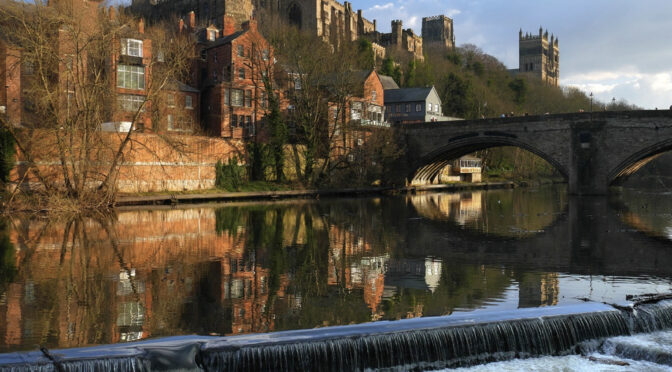
St Cuthbert’s Parish Walk
Saturday 18th March. Join fellow parishioners and friends for a gentle walk around the river and Old Durham. It will take about an hour an a half and will end in the parish room for a cup of tea and a biscuit. Meet outside church at 2pm. The legend is that St Cuthbert sent fog to hide the cathedral from German bombers during the war. Let’s hope he can keep fog and rain away for our walk.

The Feast of St Cuthbert at Durham Cathedral

Online Talk
Rev Andrew Teal, Chaplain and Lecturer in Theology at Pembroke College, Oxford, on ‘Being Christians in Today’s World.’ Details and registration at https://www.lcsb.uk/talks

St. Cuthbert’s Lecture
If you missed the lecture by Rik Van Nieuwenhove (Professor of Medieval Theology at Durham University’s Centre for Catholic Studies) on “The Beauty and Significance of Jan van Ruusbroec’s mystical theology of the Trinity”, you can still watch it on YouTube. The Blessed Jan van Ruusbroec (1293-1381) was a spiritual author of the Low Countries who developed an attractive and highly original spirituality, which influenced Spanish, French, English and German spirituality in the early-modern period. Ruusbroec describes the mystery of the Trinity as “an ebbing, flowing sea”, forever drawing us in into itself through a life of interiority and sending us out into the world through a life of charitable activity.
This is my Son, the Beloved
When Jesus took his closest disciples, Peter, James and John to the top of a mountain, they must have expected that he was about to reveal something important to them. But they could not have foreseen what actually happened. The disciples saw Jesus transfigured – shining like the sun. Moses and Elijah, the two greatest figures from the Old Testament, were with him, and the disciples heard the voice of God the Father. No wonder that Peter, James and John were terrified and confused. For the first time, Jesus was revealed to them as who he really was – the Son of God. They fell to the ground in awe of the vision that they were seeing.
But Jesus lifted his disciples up and told them ‘Do not be afraid.’ The vision was meant to give them courage for what lay ahead – Jesus’ crucifixion and death.
As we make our way through the season of Lent, a time of prayer and penance, the story of Jesus’ Transfiguration should be an encouragement for us. The words of God the Father are meant for us, too: ‘This is my Son, the Beloved; he enjoys my favour. Listen to him.’ If we remain faithful, we will be ready to celebrate the Resurrection of Christ when the feast of Easter comes.

Please Pray

Choral Evensong

Donating to St. Cuthbert’s
The easiest way to donate to the parish is by setting up a Standing Order with your bank. This leaves you in full control of any donations whilst giving the parish a fair idea as to the income it can expect towards its running costs and other expenditure. Alternatively, you may wish to donate via the parish website. We also have a weekly Envelope Scheme if you prefer to give cash or cheques and a new batch of envelopes will be available from April. If you want to know more about any of these schemes or the Gift Aid Scheme then contact Andy Doyle (andydoyle1066@sky.com or 0798 543 4185).