The annual White Flower appeal in support of the Society for the Protection of Unborn Children (SPUC) will be made at both Masses at St Cuthbert’s this Sunday 15th January 2023.

Sanctuary Lamp

Public Lecture
Are Christian discussions of LGBT issues a proxy for other theological conflicts? By James Alison. Tuesday 17th January, 5.30-7.00pm in the Senior Common Room, University College (Durham Castle.) Organised by the Durham LGBT Theology & Religion Network, in collaboration with the Centre for Catholic Studies and the Catholic Theology in Practice Network.
Catholic Theology Research Seminar
Dr Tia Noelle Pratt (Villanova University): Doing THE work: Anti-racism and the Catholic Church. Thursday 19 January 2023, 5.00-6.30pm.
Dr. Pratt, a sociologist of religion based in the United States, will discuss her research regarding systemic racism in the U.S. Catholic Church and its impact on African American Catholics. She will also discuss ways to engage the Church in anti-racism efforts.
All are welcome to join us for this seminar. Please register on Eventbrite via https://centreforcatholicstudies.eventbrite.com and the Zoom link will be sent to you.

This is my Son, the Beloved
John the Baptist was puzzled when Jesus came to him for baptism. John preached repentance to the people, but Jesus was without sin and had no need to repent. Why did he ask to be baptised by John?
Jesus’ reply to John is, ‘Leave it this way for the time being.’ The Son of God has come into the world to share everything that we experience. Later, he will sit at the table with sinners, and first, he goes into the waters of baptism with us. As he came out of the waters of the River Jordan, Jesus saw the Holy Spirit coming down on him, and the voice of God the Father was heard: ‘This is my Son, the Beloved; my favour rests on him.’ Filled with the Holy Spirit and encouraged by the words of his Father, Jesus was ready to begin his ministry of teaching and gathering disciples.
In our own baptism, we were freed from our sins, chosen by God as sons and daughters and filled with the Holy Spirit. The words that the Father spoke to Jesus are spoken to us, too: These are my beloved; my favour rests on them.
Journey in Faith

The Tablet

The Northern Brethren Fund

A message from Fr Andrew

Parish Assembly
On Sunday 15th January there will be a Parish Assembly in the Parish Room, after 10 a.m. Mass. This will include reports from the Parish Pastoral Council, the Parish Finance Council and other parish groups and committees.
If any parishioner wishes to raise a question or issue at the Assembly it should be notified in advance, by email, to parish.priest@stcuthberts-durham.org.uk by Thursday 12th January. You can also join the Assembly by Zoom – for login details, contact office@stcuthberts-durham.org.uk

Coffee Morning

Requiem Mass for Pope Benedict XVI
The Diocese of Hexham & Newcastle will celebrate a Requiem Mass for the repose of the soul of the late Pope Emeritus at St Mary’s Cathedral, Newcastle on Monday 9 January at 12.05pm. Bishop Séamus will preside at this Mass and all Clergy, Religious and Laity of the diocese are welcome to attend. The Mass will be live-streamed to the Cathedral YouTube page here. The Bishops’ Conference has produced a prayer card which you can view here.


Christmas Crib Collection
This year’s Christmas Crib collection will go to support Friends of the Holy Land, a charity which helps struggling Christian families living in the Holy Land. Details at https://www.friendsoftheholyland.org.uk/Appeal/christmas

Mass Times
News of great joy
‘Caesar Augustus issued a decree for a census of the whole world to be taken.’ This is how Luke sets the scene for the birth of Jesus. Caesar Augustus held absolute power. When he decided that a census would be taken, everyone in the Empire had to obey. So Joseph and Mary set off for Bethlehem. Mary was pregnant and close to her time, but, poor and powerless, they had to do as they were told.
When Mary and Joseph arrived in Bethlehem, they found no room at the inn, and so the baby Jesus was laid in a manger – a trough meant for holding animals’ food. The first to hear the news of the Saviour’s birth, and the first visitors, were not kings or princes but shepherds; working men who lived in the fields.
When the Son of God came into our world, he was homeless and ignored; born into a poor family in an occupied country. He would spend his whole life among the poor and the outcasts, while the wealthy and the powerful mostly rejected his teaching. In the end, Jesus became an outcast himself, driven out of the city to die on the Cross. The feast of Christmas reminds us to look into the faces of the people on the edges – those who are poor, powerless and ignored. That’s where we will see the face of Christ.

New Year’s Eve Service

Diocesan Advent Collection
We’re appealing for even greater support for our Diocesan Refugee Project during Advent this year as we prepare for the coming of the Christ Child. This is in the spirit of the comparison of the Holy Family to a modern-day refugee family made by Pope Francis. The Project relies on donations from schools and parishes throughout the diocese. There has recently been a reduction in donations from some areas thought to be the effect of the cost of living crisis on the faithful. Items for the project include toilet rolls, biscuits, sugar, rice, tea, coffee, olive oil and tinned food – specifically fish, chick peas and tomatoes. Please leave your donations in the labelled box in the narthex. Your generosity is very greatly appreciated.
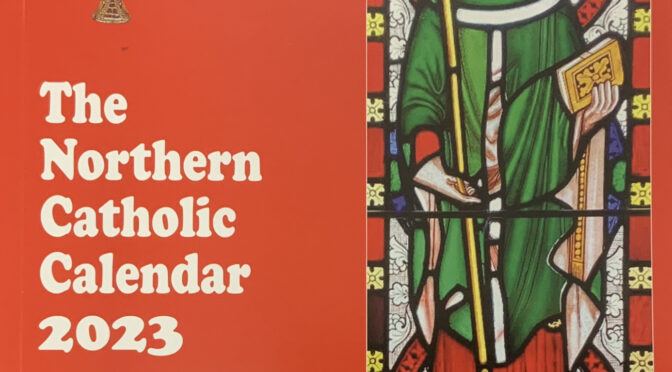
Northern Catholic Calendar
Saying ‘Yes’ to God
How did Joseph feel when he learned that Mary, his bride, was expecting a child before they had come to live together? The only explanation that Joseph could think of was that Mary had been unfaithful to him. He would feel betrayed. But he was a good man, and so he didn’t seek punishment for Mary, but instead chose to end their engagement quietly.
Joseph made an honourable decision. But God called him to go further. The angel proclaimed to Joseph that Mary had not betrayed him; her child had been conceived by the Holy Spirit. It must have seemed almost impossible to believe. But Joseph put his trust in God and took Mary to his home.
It took great courage for Joseph to obey God’s commandment, given to him through the angel – just as it took great courage for Mary to accept her own part in God’s plan of salvation, bearing the Son of God in her womb. The plan was unfolding as foretold by the prophet Isaiah in today’s First Reading. But it all depended on the cooperation of Mary and Joseph; God respected their free will, and, freely and bravely, they said ‘Yes’ to God.
We each have our own part to play in God’s plan for the world. We have free will, and we can choose whether to respond to God’s call. God asks us, like Mary and Joseph, to embrace our vocation with a wholehearted and courageous ‘Yes.’