Created and Called

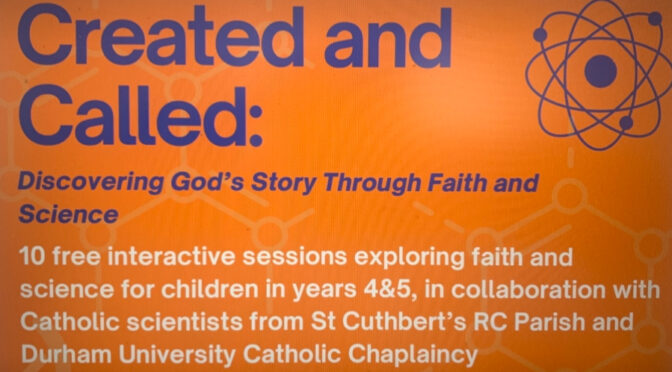
Created and Called is a programme that will enable young people to discover God’s story through faith and science.

The programme offers 10 free, hands-on sessions exploring faith and science for children in school Years 4 & 5, in collaboration with Catholic scientists from St Cuthbert’s parish and Durham University.

The sessions will be held at St Cuthbert’s in the autumn term. There will be an information evening on Thursday 27th August at 6pm, at St Cuthbert’s. To sign your child up for the programme, come to the information evening or see the poster in the narthex.


Stewarding

As most of you will know every Sunday morning there are stewards to greet you when you arrive at Mass. We are looking to add to the number of stewards that we currently have. If you think this is something you would like to get involved and to find out more about the role please see Declan after 10am Mass or contact the parish office.

Blessed are you among women

In today’s Gospel, Elizabeth greets her younger cousin Mary with the words, ‘Blessed are you among women!’ On the Feast of the Assumption, we celebrate one of the special blessings granted by God to the Mother of Jesus. At the end of her life, Mary was taken up, body and soul, to the glory of heaven. This belief goes back to the early Church and was proclaimed officially by Pope Pius XII in 1952.

Mary is blessed because she trusted absolutely in God. Because of her role in human salvation, Mary was spared by God’s grace from Original Sin and throughout her life she always gave an unconditional ‘Yes’ to God’s plan for her. She is the model disciple. Because Mary was without sin, she was spared the consequences of sin; her body was preserved from decay and corruption and was taken immediately to heaven.

We are all called to entrust ourselves to God’s word so that it shapes our lives, as it shaped the life of Mary. We are called to allow God to transform us, as he transformed Mary. Where Mary has gone, we can hope to follow. By God’s mercy, we too will be raised up, body and soul, to live with God in glory.

St Leonard’s School

St Leonard’s School is celebrating another excellent set of Sixth Form results this summer, with students achieving outstanding grades across both A Level and Vocational courses. Congratulations to the young people who have worked so hard to achieve success, and to their families and teachers. Please pray for them as they move on to employment, apprenticeships or university.

‘Lord, save me!’

Today’s Gospel begins with Jesus seeking solitude to pray, after the miracle of feeding the great crowd. But in his absence, his disciples find themselves in trouble. The Sea of Galilee is stormy and unpredictable. High winds and storms could blow up unexpectedly and even the experienced fishermen among Jesus’ disciples would feel afraid. But if they were afraid of the wind, they were terrified when they saw Jesus walking on the sea towards them.

We can see the boat in this story as a symbol of the Church: a little group of disciples afloat on a hostile sea, in the dark, tossed around by strong waves and winds. We know that we can only find safety in Jesus, and yet we don’t always recognise the Lord when we see him. Peter, meanwhile, seems to be a symbol of the individual disciple. Peter makes an act of faith and sets out to walk across the water, but he panics when he feels the wind. His cry – ‘Lord, save me’ – expresses the prayer that many of us might make when we feel overwhelmed.

The disciples recognise Jesus as ‘Son of God’ when they see his power over the wind and waves. Only he can calm the storms that frighten us.

(Picture: Rembrandt, Christ in the Storm on the Lake of Galilee, public domain via Wikimedia Commons.)

Farm Street Choir – Vespers and Concert

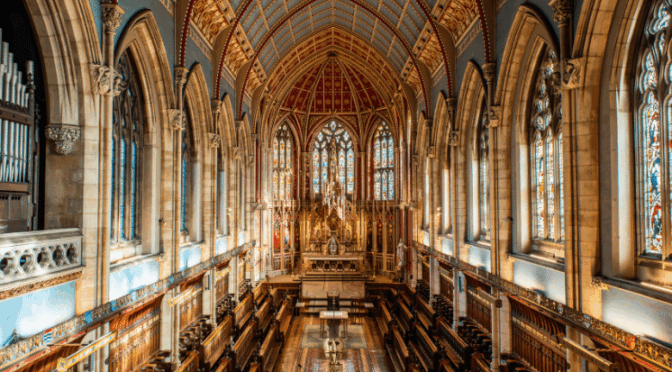
In St. Cuthbert’s Chapel at Ushaw, two of London’s finest liturgical choirs unite, for an evening for anyone who treasures the English choral tradition at its most expressive.  On Wednesday 12th August, the combined choirs of the Church of the Immaculate Conception, Farm Street & The Grosvenor Chapel, London, come together for a remarkable evening of English sacred music, bringing the Catholic and Anglican choral traditions into dialogue with Vespers at 6pm, followed by a free concert at 7pm. 

At the heart of the evening is S. S. Wesley’s monumental The Wilderness, a cantata of striking contrasts, moving between dramatic intensity and moments of tender lyricism, presented in the 150th anniversary year of the composer’s death. The programme also commemorates fifty years since the death of Benjamin Britten with his exuberant Te Deum in C, alongside Charles Wood’s radiant Hail, gladdening light, presented in his centenary year.  Further details at https://ushaw.org/whatson/farm-street-choir/.

They all ate and were satisfied

For the last three Sundays, we have heard Jesus teaching the people in parables. In today’s Gospel, he miraculously feeds a great crowd. This too is a moment of teaching.

The story begins with Jesus seeking solitude. John the Baptist has been executed by King Herod, and Jesus wants to pray and reflect. But the crowd seek him out and Jesus responds with compassion. He heals the sick and spends the whole day with the people. When evening comes, Jesus’ disciples take a practical approach: send the crowds away to buy food for themselves. But instead Jesus works a miracle to provide the food that is needed.

The miracle comes from Jesus’ compassion for the people. It shows us how God works with the little that we can bring – in this case, five loaves and two fish – to provide abundantly for God’s people. The disciples would have broken up the gathering – ‘send the crowds away’ – but instead, Jesus draws the people into community through the sharing of a meal. They will remember this day forever.

For us, the miracle of Jesus feeding the crowd foreshadows the Eucharist that we celebrate this Sunday. We come to Jesus, often feeling starved and desolate, and from his compassion he feeds us abundantly.

Partnership Proposals

As part of the current work on Mission Discernment for the Diocesan Strategy, we are working with neighbouring parishes to look at the big issues for the church in our area. We will be submitting a report to the Diocese in early August, and we need your opinions about the proposals for our area.

We are not asked to make big decisions immediately, but we are asked to identify the priorities and concerns and to set out a plan to look at those issues. We are proposing to look at 4 subjects:

  • What if we only had 3 priests for our 6 parishes?
  • Buildings and finance: we have 13 churches and13 presbyteries with a combined repair bill estimated at £1.7m.
  • How do we get more people involved in helping out in our parishes?
  • How do we make best use of websites and social media?

The attached document sets out some more detail of the proposals, and we will be asking for your feedback next weekend.

The kingdom of heaven is like treasure

In May of this year, the Vatican published Pope Leo XIV’s first encyclical letter, Magnifica Humanitas (Magnificent Humanity), on safeguarding the human person in the time of artificial intelligence. The letter is addressed to all the Catholic faithful, to all Christians and to all men and women of goodwill. In it, the Pope considers the challenges posed by new technology in the light of the Gospel and the tradition of the Church – especially Catholic Social Teaching. Leo says that he is ‘interpreting history in the light of faith;’ using ancient wisdom to understand today’s events.

In today’s Gospel, Jesus teaches his disciples that the kingdom of heaven is like a buried treasure or a fine pearl – so precious that it outweighs everything else we might wish to possess. Many scholars believe that the ‘scribe who has been trained for the kingdom of heaven’ is Matthew the evangelist himself: a scribe who had become a disciple; a teacher who brought together the ancient truths of the Scriptures and Jesus’ new wisdom of the kingdom of heaven. Today the Church continues to bring out what is new and what is old, reading the signs of the times in the light of faith and witnessing to the good news of the kingdom.

Banns of Marriage

Banns of Marriage can be seen in the narthex for Andrea Grigoletto and Elisa Canovas, whose marriage is to be celebrated at Pove del Grappa, Puglia, Italy on 28th August 2026. can be seen in the narthex for Andrea Grigoletto and Elisa Canovas, whose marriage is to be celebrated at Pove del Grappa, Puglia, Italy on 28th August 2026.

I will open my mouth in parables

Once again, Jesus uses a familiar image to convey to the crowd his teaching about the kingdom of heaven. The farmer would be horrified to find weeds growing amongst the crops that he had carefully sown. A natural reaction would be to rip up the weeds at once, but the wiser response is to allow both wheat and weeds to grow until harvest time, before separating them.

Matthew tells us that Jesus speaks to the crowd only in parables. As today’s First Reading reminds us, God’s wisdom is not human wisdom, and so Jesus uses images and stories to challenge the people and make them reflect. Here, the teaching is not to rush to judgement; the wiser course is to take time for discernment.

We can apply the parable to our own world, where we see both wheat and weeds – good and bad mixed together. We too may be tempted to rush to judgement, believing that we know the right answer. But the parable teaches us instead to be patient. Conversion is always possible and mercy is always offered to sinners. Like the wise farmer who waits for harvest time before separating out the weeds, so God waits patiently for sinners to repent.