
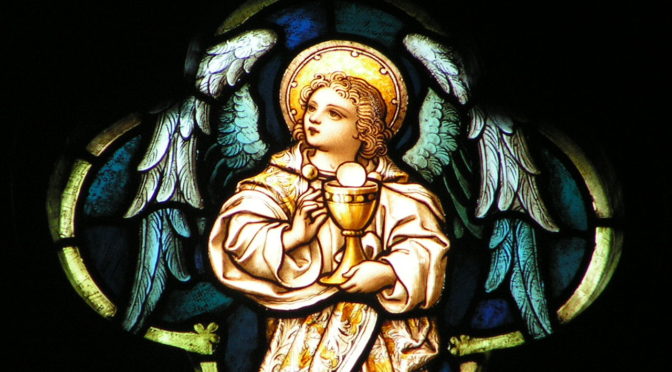
Although we hear a variety of Eucharistic prayers at Mass (another legacy of Vatican II), they share the same long history. In the middle of the second century, St Justin Martyr (whose feast we celebrated last week on 1 June), explained what happens at Mass: “There is then brought to the president of the brethren bread and a cup of wine mixed with water; and he taking them, gives praise and glory to the Father of the universe, through the name of the Son and of the Holy Ghost, and offers thanks at considerable length for our being counted worthy to receive these things at His hands. And when he has concluded the prayers and thanksgivings, all the people present express their assent by saying Amen.”
St Justin describes a scene quite similar to our experience of the Mass: the offertory, prayer, and the great Amen. Outside of Mass, however, the situation was very different. The description we have of the Mass comes from Justin’s First Apology, in which he attempted to convince the Emperor not to persecute Christians just for being Christians. Christians were accused of being stupid (by Celsus in particular, later in the second century), and were “excluded from houses and baths and markets” and even from public places in general. Yet during these same years the Church grew exponentially. (See Larry Hurtado, Why on earth did anyone become a Christian in the first three centuries?) The faith that we have received from St Justin and his contemporaries, and all those who have followed in it down the centuries, has shared this same core: the bread, the wine, the thanksgiving, and our wholehearted assent. May the Eucharist strengthen us to meet all the challenges to our faith with the courage of Justin Martyr and all the saints.


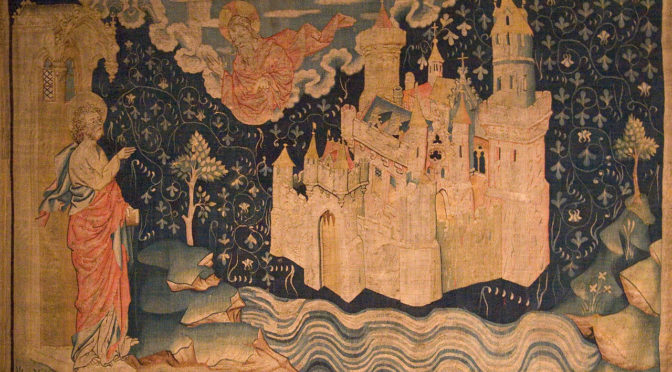

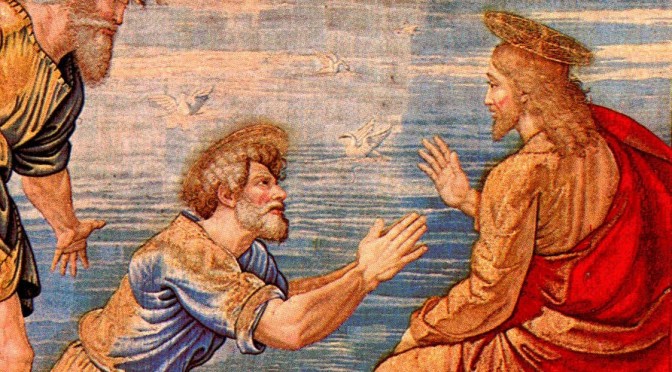


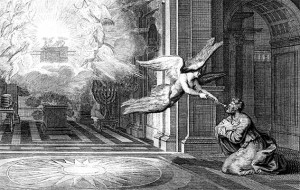 The scene that follows the announcement ‘holy, holy, holy’ is dramatic: ‘the foundations of the thresholds shook at the voice of him who called, and the house was filled with smoke’. Isaiah’s response is not worship, as we might expect. Instead, he exclaims, ‘Woe is me!’ Seeing the holiness of the Lord makes Isaiah aware of his own lack of holiness, and fearful: ‘a man of unclean lips’ should not (he thinks) behold ‘the King, the Lord of hosts’. God’s glory shows up all that is unworthy about us. Similarly Peter, in the gospel reading from a few weeks ago, responds to the miraculous catch of fish: ‘Depart from me, O Lord, for I am a sinful man’. Beholding the greatness of the Lord brings about a new, and unsettling, revelation of our own lack of sanctity. The response from on high is not judgement, however, but comfort. One of the seraphim brings a burning coal from the altar, touches Isaiah’s lips with it, and announces, ‘Behold…your guilt has been taken away, and your sin forgiven’. Likewise Jesus reassures Peter (in the same words the angel used to put Mary at ease): ‘Do not be afraid.’
 During Lent, we direct our attention to the holiness of God more than at any other time of year. Not only that: we strive to imitate that holiness. One of the ways the Church has called the holiness of God to our minds comes from the sixth chapter of Isaiah: the prophet sees the seraphim, who call out to one another: ‘holy, holy, holy is the Lord of hosts; the whole earth is full of his glory.’

 Although little noted in our contemporary liturgical observance, Septuagesima Sunday once marked an important point in the Church’s year. In the middle ages, some religious began the Lenten fast at Septuagesima, not forty days but up to seventy (as the word indicates) days before Easter. Before Lent properly began, there was a ‘little Lent’, a time of preparation for the penitential season. Even though we no longer observe this ‘little Lent’, there are good reasons at least to mark the day. My attention was drawn to the Church’s bygone practice in a homily I heard a few years ago, which has shaped my attitude to Lent (and in good measure to the spiritual life more generally). Lent is a time of preparation for Easter, but the mode of our preparation is not prescribed with rigorous detail. (More to come on what is specifically asked of the faithful during Lent.) We choose to give up things we enjoy, or take on things which will challenge us.
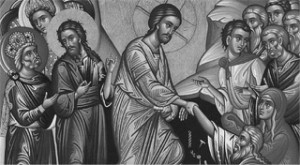 The creed concludes by directing our attention to our own end: we ‘look forward to the resurrection of the dead and the life of the world to come’. Maybe by the time we get to the last line, our attention has moved on to the next part of the Mass, or even to what’s for Sunday lunch. Or maybe the repetition week by week has dulled our perception of its oddity. The resurrection of the dead? The life of the world to come? However often we say these things, and however much we might know about the Church’s teaching on resurrection and new life, the future remains ultimately mysterious: we believe, but we do not grasp these things.