Invited to the table

Last Sunday, we heard Jesus teach his disciples that everyone is invited to the banquet in the kingdom of God. In today’s Gospel, he tells us who we should invite to our own meals. Not our family or friends, and not those who are rich or influential, whose friendship might be a benefit to us. Instead, Jesus says, we should invite the people on the edges – the poor and the disabled. 

Jesus lived in a society where people were very conscious of their social status. The guests at a formal meal would be seated in order of their importance. Anyone with a disability or serious illness would not even be invited to the table – they were believed to be cursed by God. Jesus rejects that way of thinking altogether. Not only is everyone invited to the meal in God’s kingdom, but the poor and the sick have a place of honour. The Letter to the Hebrews tells us that, in the kingdom of heaven, everyone is a ‘first-born’ and a citizen – everyone has their place at the table. What a contrast with our earthly societies, divided as they are by wealth and privilege.

Jesus himself ended his earthly life as the ultimate outsider, driven out of the city and crucified. As his disciples, we are called to follow his example and take the lowest place. Who do we not want to find sitting next to us at the table?

Goodbye Ben!

Dear all,

Unfortunately my time on placement at St Cuthbert’s has come to an end, but I would like to thank you for all the support, generosity and friendship that you have given to me whilst I have been here. From the moment I arrived, I have truly felt at home in St Cuthbert’s and I will miss the many people whom I have got to know over the past few weeks.

I would especially like to thank Fr Andrew for his patience and kindness, and for allowing someone else to share his home and his parish for a few weeks! Through his hard work I have been able to gain some valuable experience for my future placements and, God willing, life as a parish priest in our diocese. I look forward to returning to St Cuthbert’s in the future and being able to meet you all again. Finally, I would like to encourage you to not only continue praying for me and my discernment to the priesthood, but for all our diocesan seminarians and for an increase in vocations to the priesthood.

Arrivederci,

Ben

Diocesan Job Vacancies

The Diocese of Hexham and Newcastle has the following vacancies:

Cleaner, Blaydon, St Joseph and Winlaton, St Anne – part-time (8 hours), permanent

Refugee Project Worker, Newcastle – part-time (12 hours), initial 12-month contract.

Closing date for applications is 30th August.Please visit www.diocesehn.org.uk for full details or contact us 0191 243 3301. 

Called to the feast

What will happen to us after we die? What will heaven be like? Jesus tells his disciples that heaven will be a great feast – a celebration in the kingdom of God that will last forever. And when the Lord is asked, ‘Will there be only a few saved?’ his answer is ‘no.’ Everyone is invited to God’s feast. People from east and west, from north and south; people from all the strange places named by the prophet Isaiah in the First Reading, Tarshish, Mosech and Javan, will all take their places in the kingdom of God.

But Jesus tells the disciples to enter by a ‘narrow door.’ We have to choose to accept the Lord’s invitation. Jesus calls his disciples to be converted – to give their hearts to him. His words came as a warning to those who believed that they were already righteous, guaranteed a place at the top table in God’s kingdom. Jesus warns those ‘righteous’ people that they, too, need to be converted. The second reading reminds us that a father disciplines his children, to teach them the right way to live. We are all sons and daughters of God, and we are all invited to the feast, but we can never take our place for granted. Nor do we decide who else is invited. Many who are now last will be first in the kingdom, Jesus tells his disciples. We all depend on God’s mercy for our place at the feast.

Coffee after Sunday Morning Mass

Now that we are able to use social areas without restrictions, coffee and tea will  be served again after Sunday morning Mass in the parish room. Please come along and enjoy a chat with other parishioners.

We have a rota of volunteers for the first few weeks but if anyone else would like to sign up to take a turn in future they would  be most welcome.  For further details please contact Helen Schofield via the parish office or after Mass on Sunday.

The Almighty has done great things for me 

Today, the Church celebrates the Feast of the Assumption of the Blessed Virgin Mary. We believe that Mary, the mother of Jesus, because of her special part in God’s plan of salvation, was taken up directly into heaven at her death. She has gone ahead of us to eternal life with God.

The Church gives Mary the title of ‘Mother of God,’ because she brought the Son of God into the world. Even before Jesus’ birth, Mary was the first disciple to believe in him, and the first to love him. In today’s Gospel, we hear Mary’s hymn of praise, the Magnificat. Mary rejoices in what God has done for her, and in what God is doing for the whole world – pulling down the mighty, raising up the poor and the humble. The Magnificat is prayed every day in the Church’s Evening Prayer.

Mary was called by God to be the mother of his Son, and she said yes, putting her whole life into God’s hands. Like Mary, we are called by God to play our part in his plan for the world. Like Mary, we are saved from sin by the sacrifice of Christ. Like Mary, God has prepared a place in heaven for us. Where Mary our Mother has gone before us, we can hope to follow, by God’s grace.

The Pugins at Ushaw Study Day

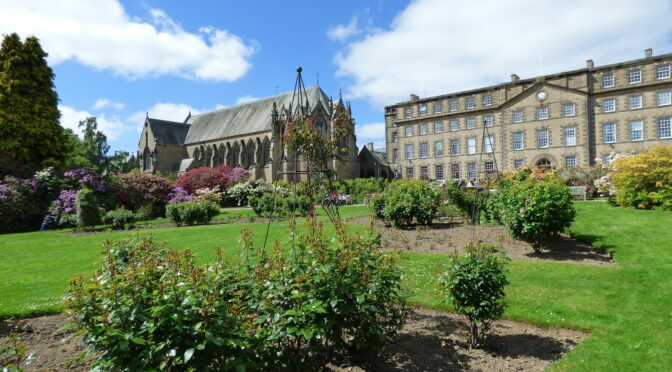
On Thursday 18th August 2022 Pugin expert Gerard Hyland will lead a study day looking at the work of the Pugin family at Ushaw. The day will include a visit to the library to see the Pugin drawings and books, viewing the Pugin church plate and vestments and a tour that will include parts of Ushaw not normally open to the public including the infirmary, bake house, maids dormitory and the nuns’ living quarters.

Tickets available at :  https://ushaw.org/whatson/the-pugins-at-ushaw/. Further details from Mike Galloway michael.galloway@btinternet.com

Where your treasure is.

We often say that ‘actions speak louder than words.’ Jesus expresses the same idea in a different way when he tells his disciples, ‘Where your treasure is, there will your heart be also.’ It’s our actions, and the choices that we make, that reveal what is most important to us.

Jesus tells Peter and the twelve apostles to be good stewards. A steward is a senior servant, responsible for taking care of the master’s property. Jesus knew that he would return to God the Father, and he entrusted the apostles with a treasure – the Good News of eternal life. He gave them the responsibility for keeping it safe and passing it on to others. He trusted them to be good stewards – faithful servants. 

To be a Christian is to be a person of hope. We live our lives in this world, but we are always looking forward to the life to come. Whatever position or possessions we may enjoy in the world, our hearts are in heaven and we put our trust in the promises of Christ. He is our real treasure.

Storing up treasure

What do we need to be happy? The man who approaches Jesus in today’s Gospel thinks he knows the answer. He needs his share of the family estate, and his brother is refusing to hand it over.

Jesus doesn’t enter into this family dispute. Instead, he takes the opportunity to teach his disciples that life is not made secure by money or possessions. However much we have, it will never be enough. Jesus tells the people a parable about a rich farmer who stores up his wealth and believes that he is secure for years to come. But he can never know when God will bring his life to an end, and he cannot take his wealth with him when he dies. The rich man is a fool, Jesus tells us; he is completely turned in on himself, cut off from the love of God and the love of others. Instead of storing up his possessions, he should be ‘making himself rich in the sight of God’ by sharing what he has and loving his neighbour.

We are always tempted to want more, and to think that this will make us secure. But everything that we have in this world – money, possessions, power or fame – will pass away. Only the love of God will remain. That is our true wealth.

Synod 2021-23: Submission for England & Wales

The National Synthesis, reflecting on Synod reports from all round England and Wales, has now been published by the Bishops’ Conference on their website. The Bishops of England and Wales are gathering to discern their response to this National Synthesis.  Their work, together with the synthesis document itself, will be sent to the Synod Office in Rome as the formal submission to the Synod from England and Wales.